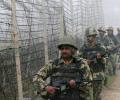
Most of India's reserves for war in the mountains have been sucked in by the standoff with China. A large part of India's airpower has also similarly been committed on the eastern border. By moving these reserves to the China border, India has been weakened vis-a-vis Pakistan. All in all, the nightmare scenario for India of a two-front war may well come true, warns Colonel Anil A Athale (retd).

It is a dark legacy bequeathed by Nehru to India. In its DNA lies the subconscious fount of India's schizophrenic geopolitics that forsook in one sweep all its historically-entrenched strategic interests in Tibet in favour of China, says R N Ravi, on the 60th anniversary of the Panchsheel Agreement.

'Modi has not taken India into confidence over what is happening and what has happened.' 'We have not even officially been told what the position is with respect to the land lost between Fingers 4 to 8,' observes Aakar Patel.

On the border dispute, officials on both sides say the protracted boundary talks made progress, while both sides made attempts to avert tensions along the 3,488-kilometre-long Line of Actual Control, which remains undefined.
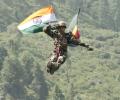
So far, the Central Sector has never seen active hostilities, remaining peaceful even through the 1962 war. A reason for the Central Sector having remained peaceful is the towering Himalayan watershed that defines the border.
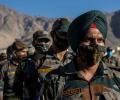
The political-electoral calculus favours spending thousands of crores on vanity projects like Sardar Patel's statue and the Central Vista over building up our military to handle the confrontations and conflicts that loom large, points out Ajai Shukla.
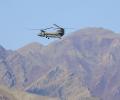
For both India and China, the most likely option -- and the most challenging -- appears to be a freezing of the status quo.

'Guarding the borders in extreme weather conditions is not easy and most people don't realize it is a very tough job.'

Lu said China will take 'further action' to safeguard its sovereignty.

Prime Minister Narendra Modi and Chinese President Xi Jinping on Thursday began summit-level talks.
'Anyone familiar with Modi's track record will know he never forgets a slight, a betrayal,' notes Virendra Kapoor.
'The BJP has done the Uri surgical strikes, handled the Dokalam crisis and the Balakot strikes.' 'So if there is a de-escalation only at the diplomatic level and not resolving this issue of a colonel being killed, then it translates into public anger.'

'India has to prepare for future warfare where kinetic use of force at the border will be limited. War will take place in the realms beyond the border.'

Besides the border question, India and China discussed issues related to counterterrorism including Beijing's blocking of India's bid in the United Nations to ban Pakistan-based JeM chief Masood Azhar, National Security Advisor Ajit Doval said on Thursday.

'China, much more than Pakistan, is a credible potential adversary with the ability to hurt our interests.' 'It must figure higher in our national security concerns,' says Vice Admiral Premvir Das (retd).
Public interest centres on whether the two leaders might make headway in resolving the Sino-Indian boundary dispute.

'Magnanimity and appeasement have no place in the world of realpolitik as India has learned the hard way,' notes Vivek Gumaste in the first of a two-part column.
The move was aimed at 'reaffirming China's claim over the state'. China claims the state as 'South Tibet'.

'The Chinese made their point repeatedly after August 5. They backed Pakistan more overtly than in the past.' 'Kashmir is not completely off their radar. But in order to keep the atmosphere surrounding the Chennai meeting, they did not discuss Kashmir.'
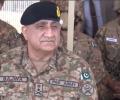
'The picture only looks worse from where Bajwa sits.' 'He sees a domineering India to the east, an unravelling Afghanistan and a complex Iran to the west, an overbearing China on the north and a US which is no longer an ally,' observes Shekhar Gupta.
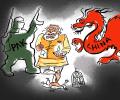
'China need not worry about a truly 'resurgent India'.' 'It's not going to happen.'

India must break out of this strategic triangulation between China and Pakistan. We need to settle our issues with one of the two, notes Shekhar Gupta.

'I don't see how any Indian government or any Indian military leadership can now ask the soldiers to patrol without weapons.'
'India and China have the wise and sage leadership to steer this complex relationship in the coming decades.'
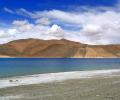
'It is pure luck that we did not have any body bags, otherwise things could have been nasty.'
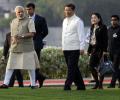
No Indian government has taken on China like this ever before and shows that the three top Indian officials -- Sushma Swaraj, Manohar Parrikar and Ajit Doval - ran into China's Great Wall on the twin questions of Pakistan and terror when they interacted with their Chinese interlocutors In past few days, says Rajeev Sharma.

Nevertheless, border dispute will feature prominently on Modi's agenda but the matter won't be discussed at length. Nayanima Basu reports

'Could the Chinese have taken a leaf out of our book?' 'That their unprecedented build-up is their attempt at coercive diplomacy with India?' 'And if so, what is it that they could be expecting as a quid pro quo?' asks Shekhar Gupta.

'Given the way in which the PLA operates today, I don't believe local commanders were necessarily acting without approval of higher levels.' 'They were acting in a way which they believed they were carrying out the intent of the higher levels.'
'The need of the hour is to build on the positives and control the negatives,' says Colonel (Dr) Anil A Athale (retd).

Prime Minister Modi made a strategic blunder of Nehruvian proportions -- presuming no war can happen now, and the Chinese won't be a military threat and risk their economic interests, observes Shekhar Gupta.
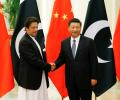
Gilgit Baltistan's large frontage with Kashmir and Ladakh across Kargil and the Siachen Glacier gives Pakistan and China the perceived scope for conduct of collusive operations against India and wrest control of the major course of the Indus and Shyok, observes Lieutenant General Syed Ata Hasnain (retd).
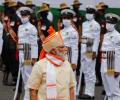
In a time of crisis like this, a government needs its people and politics united. A nation of India's size and diversity can't fight a stronger rival with fraying social cohesion, observes Shekhar Gupta.

'This is potentially escalatory, as China does not believe that India has any basis for interfering in a bilateral dispute between China and one of its neighbours.'

Outlining eight "pillars" for the future of India-China relations, President Pranab Mukherjee on Wednesday underlined the need for comprehensively resolving challenges including the boundary question through "political acumen" and "civilisational wisdom".

'Like Nehru, too, Modi has found dealing with Beijing more and more difficult and has adopted an increasingly assertive approach towards managing India's northern neighbour.'
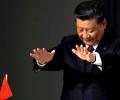
'Ladakh is a tiny salami-slice issue.' 'The big one for China is Arunachal Pradesh, more than 83,000 sq km.' 'Do they imagine they can grab any of this by force?' 'In the 21st century, nursing those thoughts only means you need to get your heads examined.' 'It isn't going to happen,' declares Shekhar Gupta.
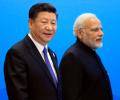
'There is a compulsion to look hard, decisive, and risk-taking; start something; and then conclude it in a way you can claim victory.' 'That is not such an easy option against China,' notes Shekhar Gupta.

'China's excessive military aid to Pakistan is the real elephant in the room as far as Sino-Indian relations are concerned. India should be confident enough to accept a degree of closeness between China and Pakistan, since China may wish to use this link for its foray into the Muslim world.' 'But the Chinese must be realistic enough to know that as time passes, the tactic of using Pakistan as a proxy to check India will yield diminishing returns. The US tried it for 60 years but failed, so will China,' says Colonel Anil A Athale (retd).

'Clearly, there is a wide gap between the stated intentions of China's top leadership to improve relations with India and the PLA's aggressive border management,' says Brigadier Gurmeet Kanwal (retd).
